
Zero-Clearance Firebox Installation
A UL-listed firebox set strictly to its listing — chase, venting, and all.
Learn moreBuilding a masonry fireplace from scratch — including the tall, shallow Rumford designs prized for radiant heat — is the kind of project where one crew controlling every stage makes the difference between a fireplace that draws and one that smokes. We engineer the firebox geometry, throat, and smoke chamber to the ratios that make a fireplace draft, lay it in firebrick and refractory mortar on a code-depth footing, and finish with a proper overhanging crown and outside combustion air. From footing to cap, it's a single coordinated build — a fireplace you light without thinking, that actually heats the room.
A masonry fireplace is the one feature a home is built around, and the one most often built wrong. Get the firebox geometry, throat, and smoke chamber slightly off and you own a beautiful fireplace that smokes the room every time you light it. Texas Service Experts builds masonry fireplaces — including tall, shallow Rumford designs prized for radiant heat — the way they should be built: engineered to draft correctly the first time and crafted in firebrick and refractory mortar to last generations. And because one crew lays the footing, the firebox, the flue, and the crown, the fireplace is built as one continuous system rather than passed between trades.
Drafting is physics, not luck. The Rumford geometry that throws heat — tall opening, shallow firebox, sharply angled covings — only performs when every ratio is honored: the opening-to-flue area, the throat dimension, the smoke shelf, and a smoke chamber corbeled to a smooth, symmetric slope. We lay the firebox course by course in firebrick set in refractory mortar to spec, parge the smoke chamber smooth so it streamlines draft instead of catching creosote, and size the flue to the opening. This is the engineering most masons skip — and the whole reason our fireplaces pull cleanly.
A full system, not just a pretty face, is what the build amounts to. We pour a code-depth reinforced footing to carry the mass, set the steel lintel over the opening, stack and bed clay flue tile (or run a listed liner) plumb course by course, build the chase or stack, and form-and-pour a proper overhanging crown with a drip edge so water sheds clear of the brick for the life of the chimney. In a tight modern home we recommend — and run, where local code calls for it — a dedicated outside combustion-air intake so the firebox draws makeup air from outdoors rather than starving the room.
Finish is where a TSE fireplace announces itself: the firebox laid clean and true, the hearth extension built to the code-required projection, the surround detailed to the design. Because we control the structure beneath the finish, the visible work sits on something sound — no hairline-cracking firebox, no settling hearth, no crown that sheds water down the face. We sequence each stage to cure and be inspected before the next, and we pull the build permit and coordinate rough-in and final inspections.
With our crew, a custom masonry fireplace build (rumford) is never guesswork. We scope every job from a graded, photographed inspection first — the NFPA 211 level the evidence calls for — so the work is matched to what your flue and masonry actually need, with the report to prove it. The documented inspection is the record the custom masonry fireplace build (rumford) is built on.
Chimney inspectionA custom masonry fireplace build (rumford) isn't a matter of opinion — it's held to published national standards. Texas Service builds every job to the named codes below and documents it, so the work is provably right for an inspector, an insurer, or a future buyer. These are the universal standards; your city's permit and inspection requirements are confirmed with the local authority before we pull the job.
Draft in a masonry fireplace lives or dies on proportion: opening-to-flue area, throat dimension, smoke shelf, and smoke-chamber slope all have to be right, and that is the geometry we build to so the firebox pulls cleanly from the very first fire.
Formed to overhang the brick with a drip edge, the crown sheds rain clear of the masonry for the life of the chimney rather than letting it wash down the face.
Tightly built houses do well with a dedicated outside-combustion-air duct, a recommended practice that some local codes require; it feeds the firebox makeup air from outdoors so the fire never depressurizes the house and pushes smoke into the room.
Following NFPA 211 smoke-chamber practice, the corbeled smoke chamber gets parged smooth and symmetric, which streamlines the draft and gives creosote fewer rough surfaces to cling to.
Codes cited are the established national standards (NFPA, UL, IRC) that govern this service. The adopted code edition, permit, and inspection requirements vary by city —Texas Service verifies them with your local authority having jurisdiction on every job.
Engineer the Rumford or traditional geometry, then pour a reinforced footing at code depth.
Lay the firebrick firebox, then corbel and parge the smoke chamber until it is smooth and symmetric.
Stack flue tile or liner dead plumb, frame the chase, and form-and-pour an overhanging crown with a drip edge.
Run the combustion-air intake where it is required, detail the hearth and surround, and inspect.
We've worked on 1,000+ DFW homes over 10+ years. Every job — small sweep or full rebuild — runs the same way: certified technicians, written quotes, photo reports, warranty in writing.
Firebox, throat, and smoke-chamber geometry sized to draft properly, not left to guesswork
Rumford and traditional builds laid in firebrick and refractory mortar to spec
Reinforced footing, a correctly sized flue, an overhanging crown, and an outside-air intake
Permitted, inspected, and staged so each layer cures before the next one goes on
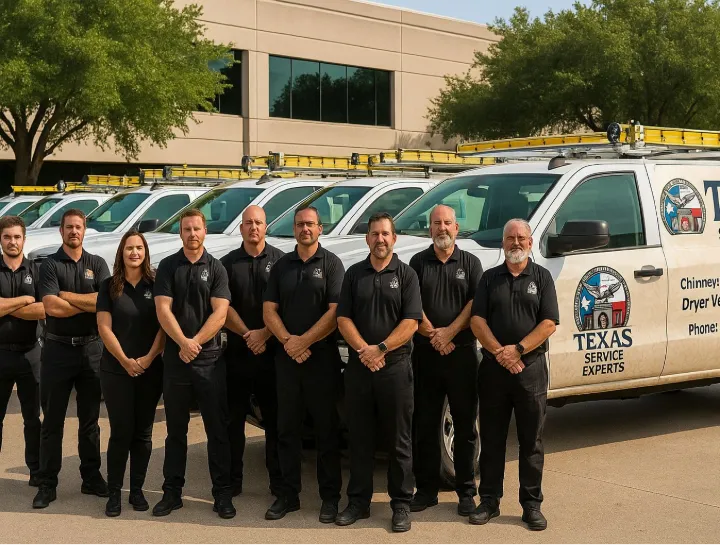
Family-owned, CSIA-certified, NFPA 211–compliant. We're the team you call when you want it done right the first time — no rotating subcontractors, no upsell pressure, no surprises. Same techs, same trucks, same standard.
The NFPA recommends a Level 1 inspection every year, with a sweep once buildup reaches 1/8" of creosote — for a wood fireplace you actually use, that's about once a heating season. The neighborly part: since we're already on the roof, the same crew checks your dryer vent and caps the visit with a quick whole-home safety look, so one appointment covers what would otherwise be three.
Yes — our inspectors hold current CSIA (Chimney Safety Institute of America) certifications, verifiable in the CSIA member directory at csia.org, and we have NFI specialists for fireplace work. The same trained crew handles your chimney, fireplace, dryer-vent and air-duct needs, so you're not juggling four different contractors for one house.
Yes — 24/7 response (subject to crew availability) for active leaks, an animal trapped in the flue, post-fire damage, and storm damage, same-day in most cases. One call reaches one crew that can handle whatever the situation turns out to need, instead of bouncing you between specialists while the water's still coming in.
Always — a written quote before we lift a tool, with photos of what we found, so you see exactly what you're approving. If the same visit turns up something in the dryer vent or ducts, it goes on one itemized quote and one invoice rather than a string of separate trips.
The Whole-Home Care Plan is our annual maintenance plan at $19.99/month ($240/year): a Level 1 inspection and sweep ($248 value), priority scheduling, 10% off all repairs, and emergency-response priority. Because one crew covers chimney, fireplace, dryer-vent and ducts, the plan keeps the whole house on a single schedule instead of a calendar full of separate service calls. Cancel anytime, no contract.
Last reviewed:
Other services in the New Construction & Outdoor category.
Free written quote. Same-week scheduling. 24/7 emergency response when you need it.
Active leak, animal in flue, post-fire damage, or smoke event? Real humans on the line 7 AM to 12 AM every day — replies in under 2 minutes. Tech dispatch within 2 hours during business hours, subject to crew availability after-hours.
Emergency line