
Electric Fireplace Repair
Heater, blower, remote, or flame-effect acting up? One tech sorts it out.
Learn moreSome valves are too far gone to nurse back, and trying to is false economy. We replace the whole assembly with an OEM-compatible part — usually a millivolt valve for standing-pilot systems or an electronic ignition module — and verify it under pressure before leaving. One crew owns the diagnosis and the replacement, so the fireplace comes back online safely in a single visit, with the gas work tested rather than assumed.
Replacing a fireplace gas valve is what's left when the valve can no longer be restored — and that's the deliberate starting point of this service, not its fallback. The valves in modern gas fireplaces are sealed assemblies; once the fault is inside the body (gas weeping past the internal seat, a cracked casting, a regulator that won't hold pressure, a control that won't positively shut off), there's nothing on the outside left to service. The whole valve comes out and a new one goes in. Texas Service Experts performs this as a precise component-replacement install — and because one crew handles the flue, venting, and fireplace together, the new valve is commissioned in the context of the whole system, not bolted in by a parts-swapper who's never seen the rest of it.
How this differs from fireplace-gas-valve-repair: repair restores a serviceable valve by freeing the linkage, re-sealing external connections, and renewing the proving circuit — it's the first thing tried. Replacement is the step that exists for the faults repair can't reach: an internal leak, a cracked body, or a valve so old its parts and matches are gone. If you're on this page, the diagnosis has already established that the valve body, not its periphery, is the problem. We confirm that boundary before opening the gas train, because a new valve is the right fix for a dead body and the wrong fix for a stiff knob.
The matching is where a replacement goes right or wrong, and it's exacting. The new valve has to match three things at once: the fuel (a natural-gas valve and an LP valve meter at different pressures and aren't interchangeable), the appliance's BTU input rating (an undersized valve starves the burner; an oversized one over-gasses it), and the control type your system uses — manual key, millivolt standing-pilot, or electronic/remote-ready. A remote-paired fireplace needs a valve its receiver can drive; a millivolt system needs one its thermopile can power. We identify the make, model, fuel, and control architecture and source the listed valve for it — never a generic substitute forced to fit.
Opening the fuel connection is what sets a replacement apart from a repair and raises the bar on the install. We verify the supply is isolated and off, lift the failed valve out without disturbing the burner or pilot geometry, and make up the new valve with the correct connector, sediment trap, and gas-rated thread sealant. Then the whole train gets proved: a manometer hold test, bubble-soap on every made-up joint, inlet and outlet pressure dialed to the rating plate, and an ambient CO check at light-off. Because a replacement usually triggers a permit and inspection, we log the valve model and the test results into the file your inspector — and your insurer — will ask for.
A bolted-in valve isn't a finished job; a fireplace that lights cleanly is. So once the new valve proves out, we re-commission the unit on it — confirming the pilot proves and holds, re-pairing the remote or thermostat if the control type changed, and watching the burner light and modulate the way it should. The replacement is done when the fireplace lights clean, holds a positive shutoff, and reads safe on the instruments, not a moment before.
We're direct about why you're replacing rather than repairing, and we put it in writing. A failed valve body isn't a judgment call we make to sell a part — it's a leak test or a pressure test that the old valve cannot pass. Doing it right here means the new valve is the correct one for your fuel, your BTU, and your controls, installed to code and documented, so the appliance is genuinely safe rather than merely lit again.
With our crew, a gas valve replacement is never guesswork. We scope every job from a graded, photographed inspection first — the NFPA 211 level the evidence calls for — so the work is matched to what your flue and masonry actually need, with the report to prove it. The documented inspection is the record the gas valve replacement is built on.
Chimney inspectionA gas valve replacement isn't a matter of opinion — it's held to published national standards. Texas Service builds every job to the named codes below and documents it, so the work is provably right for an inspector, an insurer, or a future buyer. These are the universal standards; your city's permit and inspection requirements are confirmed with the local authority before we pull the job.
Only a listed valve matched to the appliance's fuel, BTU input, and control type goes in, installed to the NFPA 54 National Fuel Gas Code; a generic substitute or an obsolete part forced to fit never does.
Restoring gas service waits until the new valve and every made-up joint have passed a manometer pressure test and a bubble test with zero leaks, and until inlet and outlet pressures are set to the rating plate.
Permits and an inspection typically come with opening the fuel connection, so we document the valve model and the test results for the inspector and for the homeowner's insurance file.
Before we hand the fireplace back, we light it off and run an ambient CO reading to prove combustion and venting are safe.
Codes cited are the established national standards (NFPA, UL, IRC) that govern this service. The adopted code edition, permit, and inspection requirements vary by city —Texas Service verifies them with your local authority having jurisdiction on every job.
Verify the body — not the periphery — is the fault.
Source a fuel-, BTU-, and control-correct valve.
Remove the failed valve; make up the new one to code.
Pressure/leak/CO test, set pressure, record for inspection.
We've worked on 1,000+ DFW homes over 10+ years. Every job — small sweep or full rebuild — runs the same way: certified technicians, written quotes, photo reports, warranty in writing.
Fuel-, BTU-, and control-matched code-rated valve
Only after repair is ruled out — no premature swaps
Full pressure + leak test on the rebuilt gas train
Permit- and inspection-ready documentation
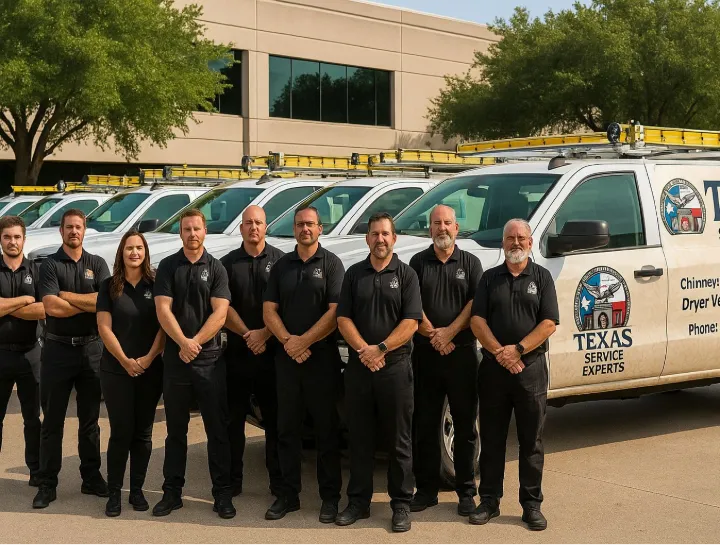
Family-owned, CSIA-certified, NFPA 211–compliant. We're the team you call when you want it done right the first time — no rotating subcontractors, no upsell pressure, no surprises. Same techs, same trucks, same standard.
The NFPA recommends a Level 1 inspection every year, with a sweep once buildup reaches 1/8" of creosote — for a wood fireplace you actually use, that's about once a heating season. The neighborly part: since we're already on the roof, the same crew checks your dryer vent and caps the visit with a quick whole-home safety look, so one appointment covers what would otherwise be three.
Yes — our inspectors hold current CSIA (Chimney Safety Institute of America) certifications, verifiable in the CSIA member directory at csia.org, and we have NFI specialists for fireplace work. The same trained crew handles your chimney, fireplace, dryer-vent and air-duct needs, so you're not juggling four different contractors for one house.
Yes — 24/7 response (subject to crew availability) for active leaks, an animal trapped in the flue, post-fire damage, and storm damage, same-day in most cases. One call reaches one crew that can handle whatever the situation turns out to need, instead of bouncing you between specialists while the water's still coming in.
Always — a written quote before we lift a tool, with photos of what we found, so you see exactly what you're approving. If the same visit turns up something in the dryer vent or ducts, it goes on one itemized quote and one invoice rather than a string of separate trips.
The Whole-Home Care Plan is our annual maintenance plan at $19.99/month ($240/year): a Level 1 inspection and sweep ($248 value), priority scheduling, 10% off all repairs, and emergency-response priority. Because one crew covers chimney, fireplace, dryer-vent and ducts, the plan keeps the whole house on a single schedule instead of a calendar full of separate service calls. Cancel anytime, no contract.
Last reviewed:
Other services in the Gas & Fireplace category.
Free written quote. Same-week scheduling. 24/7 emergency response when you need it.
Active leak, animal in flue, post-fire damage, or smoke event? Real humans on the line 7 AM to 12 AM every day — replies in under 2 minutes. Tech dispatch within 2 hours during business hours, subject to crew availability after-hours.
Emergency line